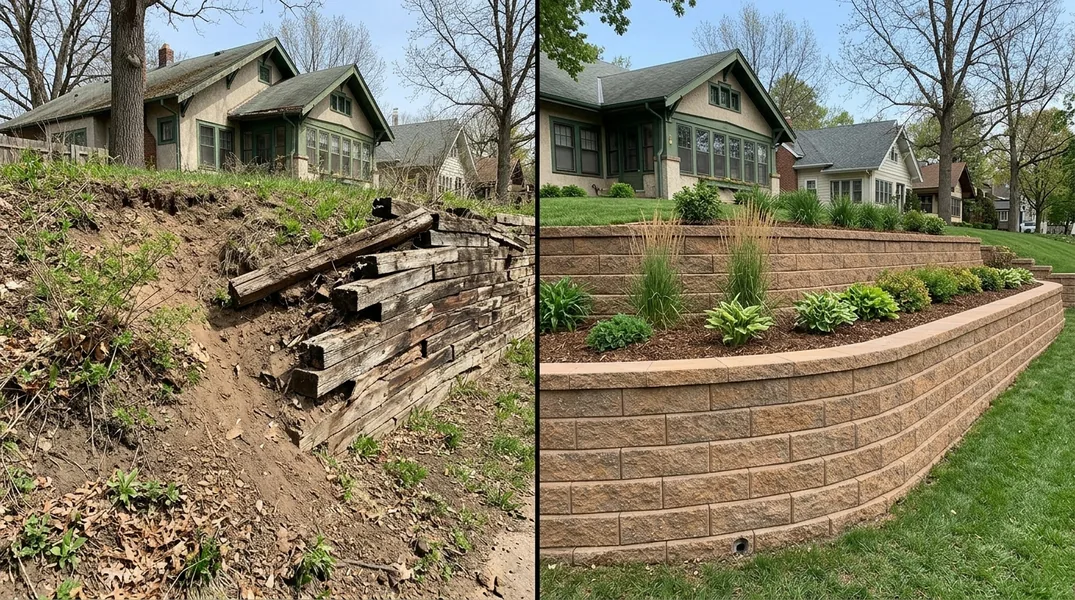
Why Spring Is the Most Dangerous Season for Retaining Walls in Minneapolis
Spring in Minneapolis brings a dramatic thaw. Weeks of snowpack melt in a short window, and the ground goes from frozen solid to saturated mud. For a retaining wall, this is the ultimate stress test. Water that was locked up as ice suddenly becomes free-flowing, and it has to go somewhere. If your wall was not built with drainage in mind, that water goes straight into the backfill soil, where it pushes against the wall with enormous force.
Most homeowners never think about what happens behind the wall. They see the finished face, the caps, and the landscaping, and assume everything is fine. But the real battle happens underground. In Minneapolis, the freeze-thaw cycle is aggressive, and spring is when years of small drainage problems suddenly become visible cracks, bulges, and leaning sections. Understanding this seasonal pressure is the first step toward protecting your investment.
Hydrostatic Pressure: The Invisible Force That Topples Walls
When water saturates the soil behind a retaining wall, it creates what engineers call hydrostatic pressure. Think of the soil as a saturated sponge. Water fills every pore, and that water pushes outward in all directions. The wall is the only thing holding it back. A properly designed wall accounts for this, but only if the water can drain away quickly. Without a path out, the pressure builds until the wall cracks, bows, or fails entirely.
This is why retaining wall drainage is not a luxury, it is a structural requirement. A wall that looks solid can be quietly losing the battle behind the scenes. In many cases, the first sign of trouble is a bulge near the middle or a horizontal crack that appears after a heavy spring rain. By the time you see these symptoms, the pressure has likely been building for years. If you notice any of these warning signs, it is worth scheduling a professional inspection before the damage spreads.
How Retaining Wall Drain Tile Relieves Pressure
The most effective defense against hydrostatic pressure is a well-designed retaining wall drain tile system. This typically consists of perforated pipe wrapped in filter fabric and surrounded by washed gravel, installed at the base of the wall behind the backfill. As groundwater collects, it flows into the pipe and is directed away from the wall, often to a daylight outlet or a dry well. Gravel allows water to move freely, while the fabric keeps fine soil particles from clogging the system.
Drain tile alone is not enough. It must be paired with free-draining backfill, proper compaction, and often a drainage board or geotextile against the wall face. When these components work together, water never gets the chance to build up. For homeowners dealing with an existing wall that shows signs of water damage, Retaining Wall Repair can often retrofit better drainage without a full rebuild. The key is catching the problem before the structural integrity is compromised.
Frost Heave and the Freeze-Thaw Cycle
Frost heave is another major threat specific to cold climates like ours. When soil freezes, water in the pores expands, lifting the ground and anything sitting on it. For a retaining wall, this can mean the footing is pushed upward or the backfill swells and shoves the wall forward. Repeated freeze-thaw cycles over a single winter can gradually shift a wall out of alignment. By spring, the damage may be obvious, but the process started months earlier.
Proper foundation depth is critical. In Minneapolis, footings must extend below the frost line to avoid being lifted by expanding soil. A wall built too shallow may survive a few mild winters, but a hard freeze will eventually take its toll. Concrete Retaining Walls are often more resistant to frost movement because of their mass and rigid construction, but even concrete needs correct footing depth and drainage to perform well long-term.
Warning Signs Your Wall Is Losing the Drainage Battle
Homeowners should watch for several red flags each spring. Bulging or bowing in the middle of the wall is a classic sign of hydrostatic pressure. Horizontal cracks, especially near the base, suggest the wall is being pushed outward. Soil settling behind the wall or sinkholes appearing on the surface can indicate that backfill is washing away. Efflorescence, a white chalky deposit on concrete or masonry, points to water moving through the wall and evaporating on the face.
Another common symptom is water pooling at the base of the wall after rain, or a soggy, spongy lawn directly behind it. These signs mean water is not being redirected properly. Ignoring them rarely saves money. A small drainage fix now is far cheaper than a full Retaining Wall Replacement later. If you are unsure whether your wall is at risk, a professional assessment can give you clarity before the next heavy rain.
Retaining Wall Installation Near Me: Getting Drainage Right the First Time
If you are planning a new wall, the best way to avoid these problems is to build it right from the start. Proper Retaining Wall Installation includes a stable base, correct footing depth, free-draining backfill, and a complete drain tile system. It also means planning where the water will go, not just hoping it disappears. A reputable installer will walk you through these details and explain why each layer matters.
For homeowners in the area, working with a local crew that understands our soil and climate makes a real difference. If you are searching for retaining wall installation near me, look for a contractor who talks openly about drainage and frost depth, not just block styles and colors. Minneapolis Retaining Wall serves the Minneapolis area and can evaluate your site, explain your options, and provide a free estimate with no pressure. Call (612) 429-3704 to schedule a visit and get ahead of spring damage this year.
Looking for a professional retaining wall contractor in Minneapolis? Minneapolis Retaining Wall responds fast for all your retaining wall needs.
Get a Free QuoteOur services: Retaining Wall Installation · Retaining Wall Repair · Retaining Wall Replacement