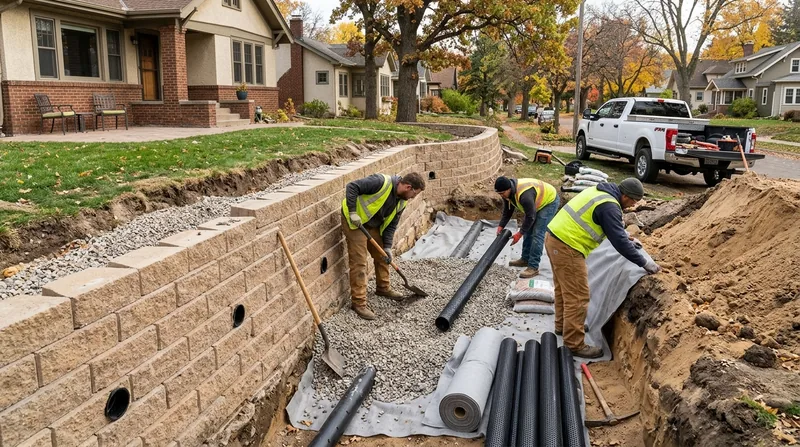




Retaining Wall Drainage in Minneapolis
Minneapolis yards sit on sandy outwash, pockets of clay till, and slopes that run down to the Mississippi gorge, Minnehaha Creek, and the Chain of Lakes. Every spring, snowmelt dumps gallons of water behind walls that were never built to drain it. If you need Retaining Wall Drainage in Minneapolis, we install drain tile, weep holes, gravel backfill, and waterproofing that relieve water and frost pressure before a wall pushes out of line. The lake basins and moraine hills toward Golden Valley and Edina make this the single most important part of any wall. We handle the drainage side of retaining wall repair every week.
Why Drainage Decides Whether a Minneapolis Wall Stands or Leans
Water is the number one cause of retaining wall failure in a snowmelt climate. When saturated soil freezes behind a wall, frost heave pushes the face outward. When it thaws, the soil loses strength and the wall slides. The old railroad tie and limestone walls in Longfellow, Nokomis, and Tangletown show this damage first because they have no drainage at all.
- Weep holes and drain tile stop hydrostatic pressure from building up behind the wall face.
- Gravel backfill with filter fabric keeps clay till from clogging the drain over time.
- Surface grading and downspout extensions move roof water away from the wall footing.
- Wall waterproofing on the soil side protects concrete and block from freeze-thaw spalling.
- Deep frost heave in Minneapolis winters makes drainage the difference between a 30-year wall and a 5-year lean.
Every drainage repair we do starts with reading how water actually moves across the lot, not just what the wall looks like.
Key info: A 1950s rambler in Richfield had a block wall that leaned 4 inches after 20 years. The wall had no weep holes and the backfill was pure clay. We installed drain tile, gravel, and filter fabric, and it has not moved since.
Local building departments set their own permit thresholds for walls, and drainage work tied to a wall replacement often falls under the same permit. Check with the City of Minneapolis building department before you start: https://www.minneapolismn.gov/.
How We Install Retaining Wall Drainage in Minneapolis
We work from the soil side out. First we expose the wall and read the grade, then we correct the water path before we touch the wall face. On hillside lots in Lowry Hill and Kenwood, that often means a French drain behind the wall plus a surface swale above it. On flat lots in Bloomington, it usually means fixing downspouts and re-grading the backfill.
- We excavate behind the wall to the footing and remove saturated or clay-heavy backfill.
- We install perforated drain tile at the footing with the correct fall to daylight or a dry well.
- We wrap the tile in filter fabric and backfill with washed gravel, not native soil.
- We core weep holes through the wall face at the low point of each panel.
- We waterproof the soil side of concrete and block walls before we backfill.
- We re-grade the surface so water runs away from the wall, then compact in lifts.
We finish by testing the drain with a hose before we close the excavation, so you know it moves water the day we leave. For walls on steep ground, we pair this with slope stabilization and erosion control.
Key info: A lakeshore home near Lake Minnetonka had a segmental block wall that bulged every spring. The drain tile had been laid flat with no fall. We re-laid it at 1 percent to a daylight outlet and the bulging stopped within one season.
Drainage Approaches We Use on Minneapolis Walls
Not every wall needs the same drainage. A poured concrete wall on a walkout lot in Edina needs waterproofing and a footing drain. A timber wall in a Golden Valley backyard needs gravel and weep holes. We match the approach to the wall material and the soil.
| Approach | Description | Best for |
|---|---|---|
| Footing drain tile | Perforated pipe at the base wrapped in filter fabric and gravel. | Concrete and block walls on sloped lots |
| Weep holes and gravel backfill | Cored outlets through the face with washed gravel behind. | Segmental block and timber walls |
| Waterproofing membrane | Soil-side coating that blocks water from entering the wall. | Poured concrete walls and basements |
| Surface regrading and swales | Reshaping the ground above the wall to shed water away. | Flat lots with downspout problems |
| Chimney drain | Vertical gravel column that carries water down to the footing tile. | Tall walls on clay till |
We pick the combination that fits your soil, your wall height, and where the water can legally daylight on your lot.
Retaining Wall Drainage Cost in Minneapolis: What to Expect
Drainage work starts from $2,500 for a typical residential wall with footing tile, gravel backfill, and weep holes. That figure covers a wall up to about 30 feet long with reasonable access. Longer walls, clay-heavy soil, and tight lots in Linden Hills or Lowry Hill where equipment cannot reach the back side push the number up.
Cost moves on four things: wall length, how deep we have to excavate, whether the wall needs waterproofing, and where the water can outlet. A dry well or a long run to daylight adds material and labor. Getting two or three estimates is smart because drainage is often bid as an add-on, and you want to compare what each contractor actually includes. Our full pricing overview breaks down the line items.
Key info: A 60-foot timber wall in St. Louis Park came in higher than a 30-foot job because we had to hand-dig the back side and haul out saturated clay. The drainage itself was the same; access and spoils drove the price.
Retaining Wall Drainage Near Me: How to Hire in Minneapolis
When you search for retaining wall drainage near me, you get a long list. Narrow it by asking three questions before anyone touches your wall. A contractor who cannot answer them clearly is not the one you want.
- Ask for their license and insurance certificate, and confirm the coverage is current.
- Get two or three written estimates that list the drain tile, gravel, fabric, and outlet separately.
- Ask for references from walls built at least five years ago in a similar soil and slope.
- Confirm who pulls the permit if your wall is over the local height threshold or supports a driveway.
- Ask how they will handle runoff on your lot and whether it can legally outlet where they plan.
Reach us through our contact page to set up a free estimate.
When to Call for Drainage Work in Minneapolis
The failure window in Minneapolis runs from late March through May, when snowmelt saturates the ground behind walls. That is when we see the most leaning, bulging, and collapsed walls in Nokomis, Longfellow, and the moraine hills toward Edina. If your wall has water pooling at the base, soil washing out of the face, or a lean that grows each spring, call (612) 429-3704 before the next freeze. We can also fold drainage into a full retaining wall replacement if the wall is too far gone to save.
Retaining Wall Drainage in Minneapolis: Pricing Guide
| Service | Price | Details |
|---|---|---|
| Drainage retrofit on existing wall | Starting at $2,500 | Footing drain tile, gravel backfill, filter fabric and weep holes for a typical wall up to 30 feet |
| Full drainage with waterproofing | Starting at $4,200 | Adds soil-side waterproofing membrane and a chimney drain on concrete or block walls |
| Long wall or tight access | Starting at $3,800 | Hand excavation and spoils hauling on lots where equipment cannot reach the back side |
| Complex or large-scale job | On estimate | Tiered walls, dry wells, long daylight runs and engineered drainage need an on-site look first |
| Travel | Included | In Minneapolis and surrounding areas, no separate call-out or mileage fee |
| Estimate | Free | Response within 24h at (612) 429-3704, no obligation to book |
Indicative pricing, the exact cost depends on square footage, finish, and site access. Free personalized estimate within 24h at (612) 429-3704.


