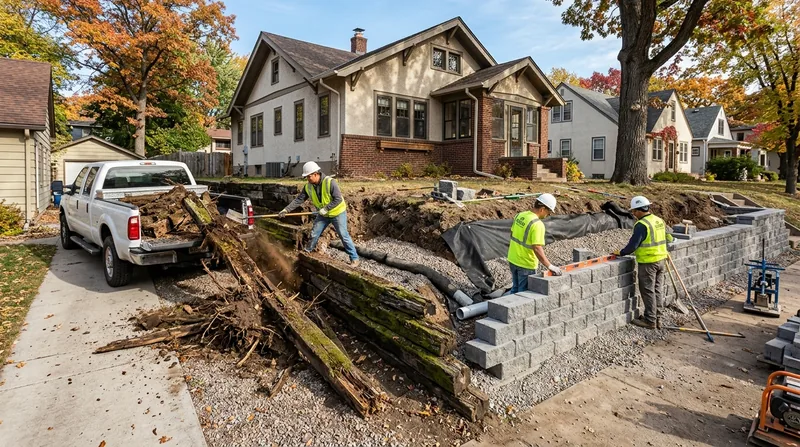




Railroad Tie Wall Replacement in Minneapolis is a job we get called for every spring, especially in Longfellow, Nokomis, and the older blocks of Linden Hills where 1980s and 90s ties are now rotting, leaning, and pushing out of line. Those creosote-soaked ties were never meant to last forty years in a climate with deep frost heave and heavy snowmelt. Our crews pull the old ties, haul them off legally, rebuild the drainage, and set a new wall in segmental block, poured concrete, or Minnesota limestone. If your tie wall is bulging, sagging, or shedding chunks of wood, we can tell you in one visit whether it needs a patch or a full rebuild. Start with our retaining wall replacement service to see how we scope a tear-out.
Why Railroad Tie Walls Fail Faster in Minneapolis Than Anywhere Else
Minneapolis sits on sandy outwash with pockets of clay till, and that soil holds water against a wall face. Add six months of freeze-thaw, deep frost heave, and a fast spring melt, and a creosote tie that would last decades in a dry climate starts to rot from the back. The dominant failure here is frost heave pushing the wall face out of line, not rot alone. Once a tie wall leans, the ties are usually too far gone to reset.
- Creosote ties from the 1980s and 90s are now at or past the end of their service life.
- Clay till traps water behind the wall and drives freeze-thaw movement every winter.
- Missing or crushed gravel backfill lets hydrostatic pressure build against the ties.
- Ties rot at the soil line, so the wall loses its batter and starts to lean outward.
- Old ties are treated wood and need legal haul-away, not a dumpster in the alley.
If you see any of these signs, get the wall looked at before the next spring melt makes it worse.
Key info: A tie wall on a Longfellow lot near Minnehaha Creek can look fine in July and be two inches out of plumb by April. Frost heave in clay till moves walls fast, and a leaning tie wall is a permit and safety issue once it passes roughly 4 feet.
Before you book anything, check the City of Minneapolis building permit rules for retaining walls, since thresholds vary by height and surcharge: City of Minneapolis permits.
How We Replace a Railroad Tie Wall in Minneapolis, Step by Step
We do not guess at what is behind a tie wall. We dig a test pit, check the soil, and look at what the wall is holding up before we quote the rebuild. On the hills in Lowry Hill and Kenwood, that often means a wall holding a walkout or a driveway, which changes the engineering. Here is the sequence we run on a typical Minneapolis tie wall replacement:
- We walk the site, measure the wall, and check for utilities, setbacks, and permit triggers.
- We excavate behind the wall and remove the old, failed backfill.
- We install new washed gravel backfill, filter fabric, and a perforated drain to daylight.
- We set a new base, build the wall in segmental block, concrete, or limestone, and compact in lifts.
- We cap the wall, restore the grade, and clean the site before we leave.
Every tie wall we replace gets new drainage, because a new wall on old, clogged backfill will fail the same way the old one did.
Key info: On a recent rebuild in Tangletown, the old ties were sitting on a clay shelf that held water all spring. We undercut the shelf, brought in gravel, and tied the new block wall into a proper drain. That is the difference between a wall that lasts and one that leans in three winters.
If the wall is already failing, see our leaning and collapsed wall repair page for how we stabilize before we rebuild.
Replacement Approaches We Use on Minneapolis Tie Walls
Not every tie wall should be replaced with the same material. A lakeshore wall on Lake Minnetonka and a garden wall in Richfield have different loads, different budgets, and different looks. We match the approach to the site, the soil, and what the wall is holding up.
| Approach | Description | Best for |
|---|---|---|
| Segmental block replacement | Engineered block wall with gravel backfill and a drain, built on a compacted base. | Most residential tie walls in Longfellow, Nokomis, and Richfield. |
| Poured concrete replacement | Cast-in-place wall with rebar and a formed face, good for tall or surcharge loads. | Driveway and walkout walls on the hills of Lowry Hill and Kenwood. |
| Minnesota limestone rebuild | Kasota or Platteville limestone set on a concrete footing with proper drainage. | Visible garden and terrace walls where the look matters. |
| Tie wall partial rebuild | Replace only the failed section and re-drain the wall if the rest is sound. | Short walls with one bad run and a tight budget. |
We tell you which approach fits before you commit, and we do not sell a full rebuild when a partial one will hold.
Railroad Tie Wall Replacement Cost in Minneapolis: What to Expect
Most railroad tie wall replacements in Minneapolis start at From $35/sq ft, and that figure covers tear-out, haul-away, new gravel backfill, drainage, and a new wall face. The number moves with wall height, access, and what the wall is holding up. A 3-foot garden wall in Edina is a different job from a 6-foot driveway wall in Golden Valley that needs engineering. Get two or three estimates, and make sure each one includes haul-away and drainage, not just the block.
Key info: A 40-foot tie wall at 4 feet high is about 160 sq ft, so the starting range lands near $5,600 before access, disposal, or engineering. A wall that needs a permit and stamped drawings will run higher.
For the full breakdown of what drives the number, see our retaining wall pricing page. We quote after a site visit, not over the phone, because the soil and the surcharge decide the cost.
Hiring a Retaining Wall Contractor Near Minneapolis: What to Check
Any contractor can rent a mini-excavator and pull ties. The difference shows up in the drainage detail and the permit paperwork. Ask for a certificate of insurance, call two recent references, and confirm who pulls the permit. In Minneapolis, walls over roughly 4 feet or walls that support a driveway or structure often need a permit, and tall or tiered walls may need engineered drawings.
- Confirm the contractor is fully insured, and ask for the certificate before work starts.
- Get at least two or three written estimates that itemize tear-out, disposal, and drainage.
- Ask for references on tie wall replacements in Minneapolis, not just new installs.
- Check HOA rules and property-line setbacks before the crew mobilizes.
- Verify who handles the permit and the disposal of treated ties.
If a bid is far below the others and skips the drain or the haul-away, walk away.
Ready to get a number? Reach out through our contact page and we will set a site visit.
Railroad Tie Wall Replacement in Minneapolis: Pricing Guide
| Service | Price | Details |
|---|---|---|
| Partial tie wall rebuild | Starting at $35/sq ft | Covers tear-out of the failed run, new gravel backfill, drain, and a block face on a short wall. |
| Full tie wall replacement in segmental block | Starting at $45/sq ft | Includes full tear-out, legal tie haul-away, new drainage, and an engineered block wall. |
| Poured concrete or limestone rebuild | Starting at $55/sq ft | Higher cost reflects forming, rebar, or stone setting plus the footing and drainage work. |
| Tall or surcharge wall (over 4 ft, driveway or structure) | On estimate | Needs an on-site look and possibly engineered drawings before a number is given. |
| Travel | Included | In Minneapolis and surrounding areas, no separate call-out or mileage fee. |
| Estimate | Free | Response within 24h at (612) 429-3704, no obligation to book. |
Indicative pricing, the exact cost depends on square footage, finish, and site access. Free personalized estimate within 24h at (612) 429-3704.


