Why Twin Cities Soil and Frost Change Everything
If you live in Minneapolis, you already know that winter here is not a minor inconvenience. It is a force that reshapes driveways, cracks sidewalks, and pushes fences out of plumb. The same freeze-thaw cycle that heaves a patio paver also exerts enormous pressure on any retaining wall holding back soil. Choosing the wrong material is not just a cosmetic mistake. It can lead to bowing, settling, and costly failures within a few seasons.
The local ground adds another layer of challenge. Much of the metro sits on glacial till, sandy loam, and pockets of expansive clay that swell when wet and shrink when dry. Expansive clay is especially hard on walls because it moves independently of the structure. A wall built for dry California soil will not perform the same way here. That is why the best material for a Minneapolis retaining wall is the one that handles both frost depth and soil movement, and why proper Retaining Wall Installation matters as much as the product you pick.
Concrete Retaining Walls: The Heavyweight Champion
Concrete Retaining Walls are poured in place and reinforced with steel, which makes them the strongest option for tall walls and heavy loads. In a climate with a frost depth of roughly 42 to 60 inches depending on the exact location, a poured concrete wall can be engineered with a deep footing that extends below the frost line. That prevents the seasonal heaving that destroys shallower structures. Concrete also resists the lateral pressure from saturated clay better than almost any other material.
The tradeoff is cost and permanence. Poured concrete is typically the most expensive option upfront, and it requires a contractor who understands local drainage and reinforcement. Once cured, though, it needs very little maintenance and can last for decades. If you plan to stay in your home long term and your wall is holding back a significant slope, concrete is often the most cost-effective choice over the life of the wall. Homeowners in Edina and other hilly suburbs frequently choose this route for that reason.
Block Retaining Walls: Versatile and Repairable
A block retaining wall built from interlocking concrete units has become the most popular choice for residential projects across the Twin Cities. These systems are engineered to flex slightly with soil movement instead of cracking, which is a real advantage when clay expands and contracts. Many block systems also include a geogrid reinforcement layer that ties the wall back into the soil, adding stability without the cost of a full concrete pour.
Block walls are also easier to repair than poured concrete. If one section settles or a unit chips, a contractor can often replace individual pieces rather than rebuilding the entire wall. That modularity keeps long-term ownership costs down. For mid-height walls, garden terraces, and driveway borders, block offers a strong balance of durability, appearance, and budget. Just make sure the installer uses proper base compaction and drainage gravel, because even the best block will fail on a poorly prepared base. If an existing wall is already showing problems, Retaining Wall Repair is often the smarter first step before considering a full rebuild.
Limestone Retaining Walls: Natural Beauty with Local Roots
Limestone retaining wall construction has a long history in the Upper Midwest, and for good reason. Limestone is widely quarried in the region, so it is a genuinely local material with a look that fits Minnesota landscapes. It is heavy, dense, and naturally resistant to freeze-thaw damage when installed correctly. Many older limestone walls around Minneapolis and St. Paul have stood for a century or more, which says a lot about the material's longevity.
The catch is that limestone walls are labor intensive. Each stone must be set by hand, and the wall needs a proper batter and drainage system to shed water. That makes limestone more expensive than block for most projects, and it is best suited to visible walls where the natural stone appearance adds real curb appeal. If you love the look of stacked stone and want a wall that could outlast your mortgage, limestone is worth the investment. For homeowners who want that natural aesthetic on a tighter budget, a segmental system with a stone texture can be a practical compromise.
Segmental Retaining Walls: The Modern Standard
A segmental retaining wall is the engineered version of the block wall, designed as a system of units, geogrid, and drainage aggregate that work together. These walls are specified by height and load, and reputable installers follow manufacturer guidelines for embedment depth and reinforcement. In a frost-heavy climate, that engineering is what keeps the wall stable through decades of winter cycles. Segmental systems are also the most design-flexible option, with dozens of colors, textures, and cap styles.
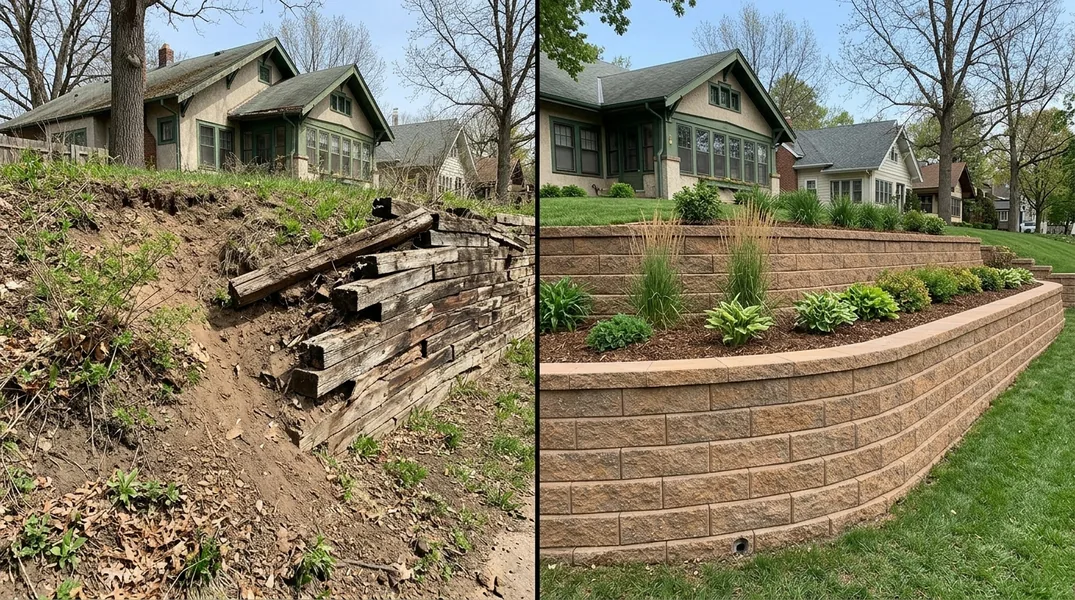
For most Minneapolis homeowners, a segmental wall is the sweet spot. It costs less than poured concrete or hand-set limestone, installs faster, and can be engineered for walls well over four feet tall. It also handles minor settlement gracefully because the units can shift slightly without cracking. If you are comparing options and want to understand how these materials affect your budget, our pricing page breaks down typical ranges. And if you are replacing an old timber or failing block wall, Retaining Wall Replacement with a segmental system is often the most durable path forward.
Retaining Wall Installation Near Me: Choosing the Right Material for Your Yard
There is no single best material for every property. A short garden terrace in Bloomington may only need a low block wall, while a tall slope behind a walkout basement in Minneapolis may require engineered concrete. The right answer depends on wall height, soil conditions, drainage, budget, and how visible the wall will be. A good contractor will evaluate all of these before recommending a product, rather than pushing whatever material is easiest to install.
If you are ready to sort through the options for your own yard, reach out for a free estimate. Minneapolis Retaining Wall serves homeowners across Minneapolis and can walk you through concrete, block, limestone, and segmental options based on your specific slope and soil. Call (612) 429-3704 to schedule a site visit and get a clear recommendation before the ground freezes again.
Looking for a professional retaining wall contractor in Minneapolis? Minneapolis Retaining Wall responds fast for all your retaining wall needs.
Get a Free QuoteOur services: Retaining Wall Installation · Retaining Wall Repair · Retaining Wall Replacement